When someone asks an AI assistant which studio could build an AI agent for their company, the answer names a handful of firms and links a few pages. If your site is not among them, you are not part of that conversation.
It does not matter much which assistant they use. ChatGPT, Claude, Perplexity, Gemini and Copilot work in a similar way: they search, read a few pages and quote what answers the question. So we rebuilt cleevio.com for all of them at once.
Does AI search actually bring clients?
For us, it already has. Between the launch on 2 October and 16 October, three companies contacted us after an AI assistant pointed them to Cleevio. For a studio where one client relationship can run for years, three leads in 14 days is a real result.
It is early, and three leads are a signal, not a trend. Here is what we built.
How should section titles be written for AI search?
Write them the way people prompt. An assistant matches the prompt it was given to the passage that answers it, and the section title tells it what that passage is about. When the title reads almost like the prompt itself, the match is obvious.
Write every section title as a prompt your reader would actually type. “How to deploy a Next.js 16 app to Vercel” will be found and cited more often than “Deployment strategies for modern frontend frameworks”, even when both articles say almost the same thing. The first is something people ask. The second is a category nobody searches for.
| Written as a topic | Written as a prompt | |
|---|---|---|
| Blog post | Deployment strategies for modern frontend frameworks | How to deploy a Next.js 16 app to Vercel |
| About page | Our approach to AI | How do we decide if a process needs an AI agent? |
| Pricing page | Pricing | How much does it cost to build an AI agent? |
Think of each section as an answer and its title as the prompt that should lead to it. Then give the answer in the first sentence under the title. Assistants cite passages, not whole pages, so one clear paragraph can be quoted while the rest is ignored.
This article does the same: its title and every section title are written the way someone would prompt an assistant about this topic, and every section opens with its answer.
What does a website need so LLMs can read it?
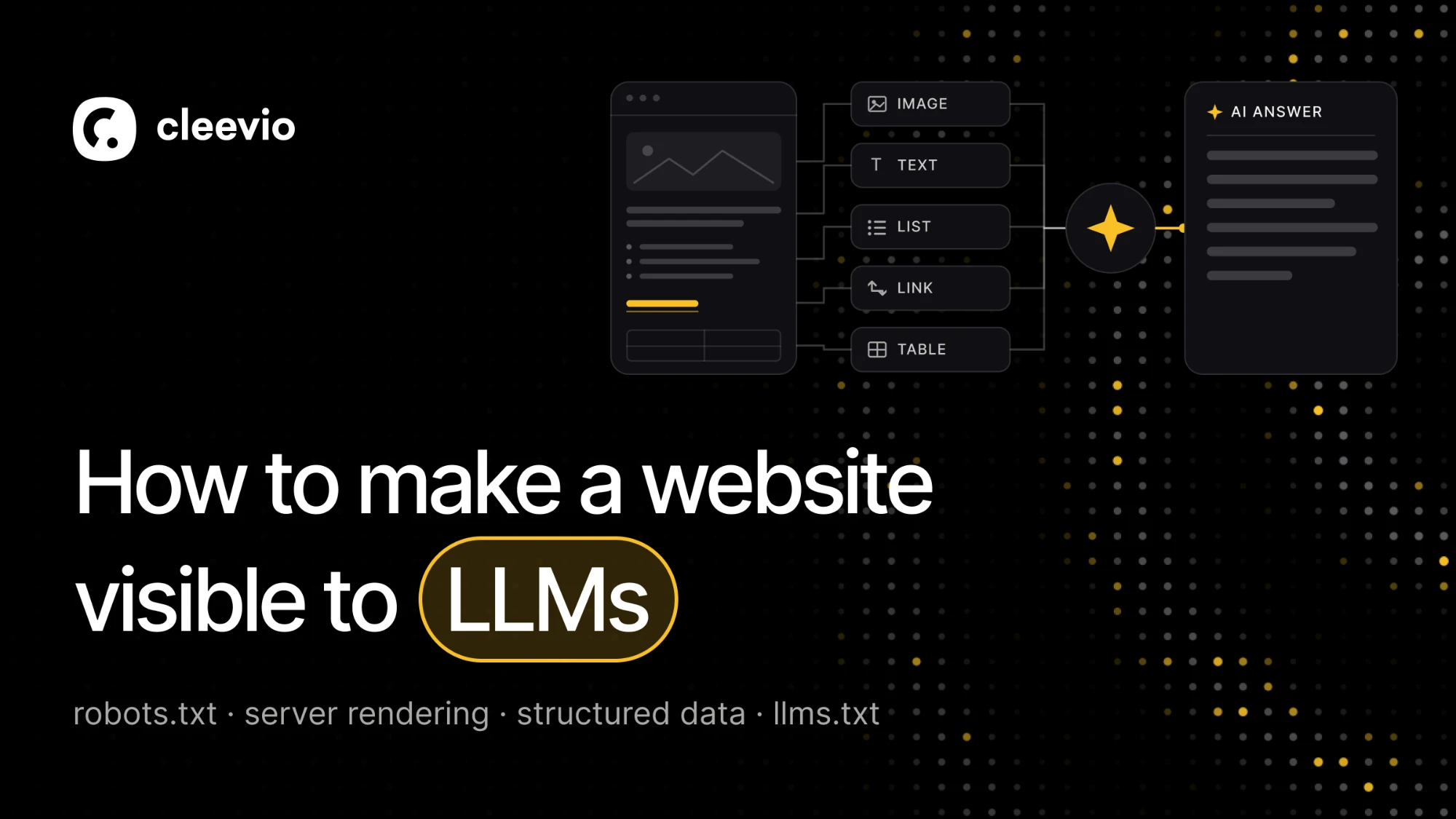
Mostly the basics, done properly. This is what runs on cleevio.com today, and you can check every item yourself.
| What | What it does | Check it |
|---|---|---|
| Open robots.txt | Lets every crawler in. Blocking an engine’s search bot removes you from its answers. | /robots.txt |
| Server rendering | Next.js renders every page on the server, so crawlers that don’t run JavaScript still read the text. | View the source of any page |
| Structured data | JSON-LD tells machines what each page is: the company, an article and its author, a service, a case study, an FAQ. | Google’s Rich Results Test |
| llms.txt | A plain-text map of our services, case studies and articles for language models, plus llms-full.txt with the full text. | /llms.txt |
| Sitemap | Generated from the site’s own content, like llms.txt, so new pages and posts join it automatically. | /sitemap.xml |
| Ask an AI | Buttons that open Claude, ChatGPT or Perplexity with a briefing about Cleevio already loaded. | The contact section below |
We let AI training crawlers in on purpose, too. We want models to know what Cleevio does even when they answer from memory without searching.
Two honest notes. No major AI company has committed to reading llms.txt, so we treat it as a cheap experiment, not a ranking factor. And not everything was about AI: the sitemap had to be adjusted to the new site structure.
How often should a website be updated for AI search?
Often enough that your key pages never go stale. People ask assistants about the present, and a page nobody has touched in a year is a weaker source. Industry studies of AI citations report that Perplexity cites content updated within the last 30 days about 3.2 times more often than older pages. Treat the exact number as directional, since it comes from vendor research rather than from Perplexity, but every study we read points the same way.
So a website is not a launch project that ends on release day. It works more like a product: new case studies, updated service pages and articles revised when the facts change keep a site in the answers. A site that sits still slowly drops out of them.
The update has to be real: new facts, new numbers, a new section. Changing the date alone does not count.
Does writing for AI search actually work?
The three leads say it can. This article follows the same rules: it is server-rendered, carries BlogPosting, HowTo and FAQPage structured data, is listed in llms.txt and the sitemap, and every section title is written as a prompt. If an assistant brought you here, you have seen it work.
What are the steps to make a website visible to LLMs?
In rough order of impact per hour spent:
- Let the search bots in. Allow the AI search crawlers in robots.txt (OAI-SearchBot, Claude-SearchBot, PerplexityBot, plus Googlebot and Bingbot), and check that your CDN or firewall does not block them anyway.
- Serve the text in the HTML. Use server rendering or static generation, so crawlers read the page without running JavaScript.
- Write section titles as prompts. Word each title the way someone would prompt an assistant about the topic, then answer it in the first sentence below, with specific numbers and dates.
- Keep the content up to date. Update your key pages with real changes, and generate the sitemap from your content.
- Measure the results. Watch referrals from AI assistants in your analytics, and ask new leads how they found you.
Does blocking AI training bots remove a site from AI answers?
- No. The big vendors run separate crawlers for training and for search: OpenAI has GPTBot and OAI-SearchBot, Anthropic has ClaudeBot and Claude-SearchBot. You can block training and still appear in AI search.
Does llms.txt help AI visibility?
- It is not proven. No major AI company has committed to reading it, and Google says its AI features don’t need it. We publish one because it costs little.
Is optimizing for AI search different from SEO?
- Mostly not. The foundations are the same: crawlable pages, clear structure and authority. The difference is that AI assistants quote passages, so every section has to make sense on its own.
We build client websites and products on the same foundations, from front-end engineering to the way the content is structured.