What does “forward deployed engineer” mean?
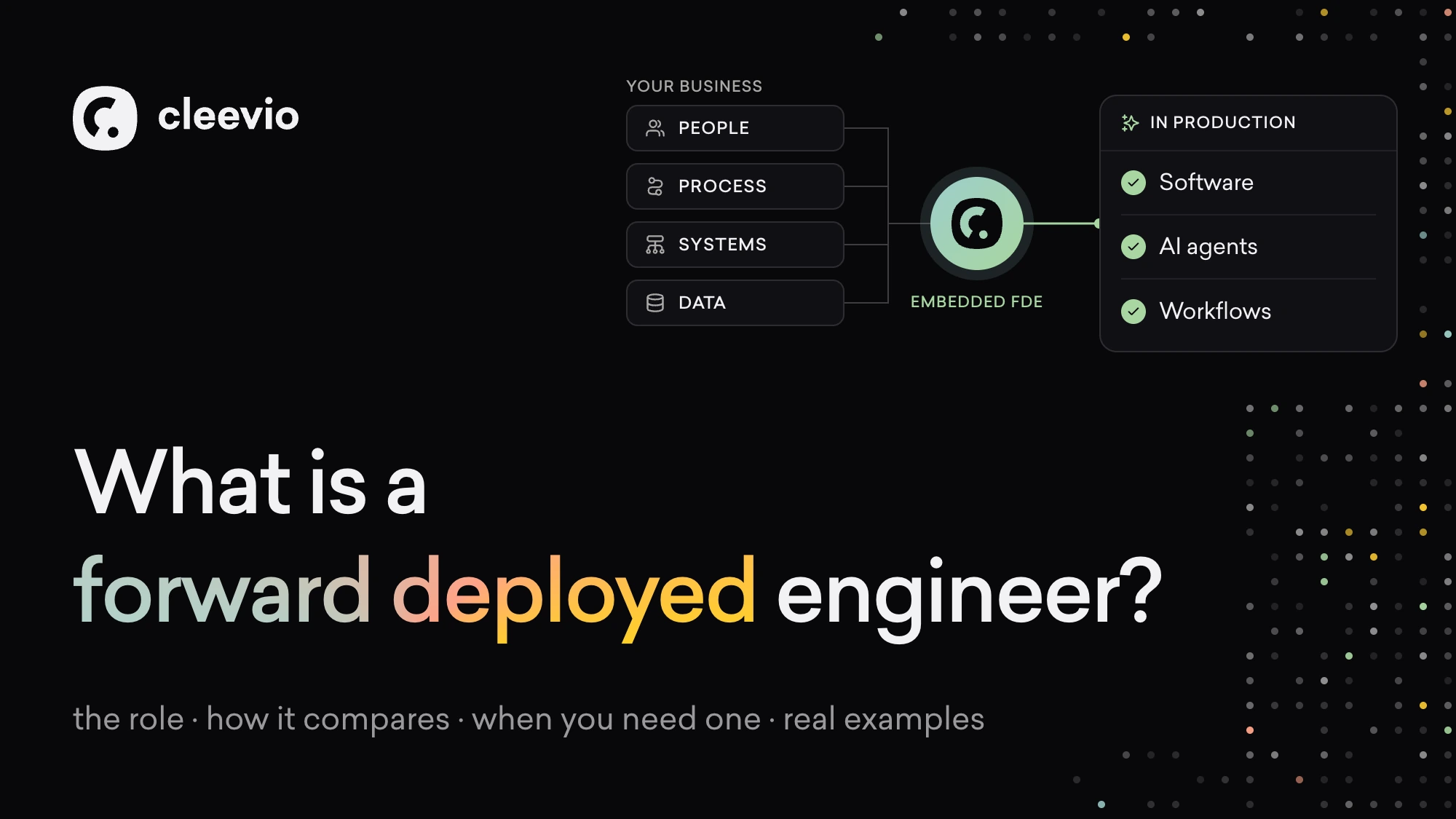
A forward deployed engineer (FDE) is a software engineer who works inside a customer’s business, alongside the people who do the work, and builds the software that solves one of their problems. They learn the process first-hand, write production code and stay with the solution through rollout.
The role is best known from Palantir, which has run its forward deployed model for years and titles the job Forward Deployed Software Engineer (FDSE). Fortune calls it “the Palantir brainchild that’s spreading across tech firms”: in September 2026, Microsoft, Meta, Google, OpenAI and Anthropic all had openings for forward deployed engineering roles.
There are two kinds. A vendor’s forward deployed engineer deploys the vendor’s own platform at a customer and adapts it. A partner’s forward deployed engineer, the kind a studio like ours provides, builds custom software for the customer’s problem with whatever technology fits.
In our projects, most of the effort in an AI system goes into connecting a model to a company’s data, systems and daily routines. That connecting work is what the role exists for.
What does a forward deployed engineer do?
The work moves through four stages, usually inside one engagement.
- Understand. Sit with the people doing the work, inspect the systems and agree on one problem, a baseline and a measurable outcome.
- Build. Ship a working first version around real workflows and approved data, with AI coding agents handling scoped implementation under engineering review.
- Deploy. Connect production systems, test the critical paths and set up access controls and monitoring.
- Operate. Support adoption, compare results with the baseline, then extend the solution or hand it over.
A week usually mixes all four. Part of it goes to watching how a request moves through an operations team’s tools and asking why each step exists. The rest goes to code: an integration, an evaluation set for an AI agent, a release. The engineer answers to the business owner of the problem as much as to an engineering lead.
FDE vs consulting, solutions engineering and staff augmentation
The four ways to bring in outside engineers differ in who defines the work and who owns the outcome. A forward deployed engineer defines the work together with the customer’s team and owns the outcome through rollout, so the engagement ends when the result is live and in use.
| Staff augmentation | Consulting | Solutions engineer | Forward deployed engineer | |
|---|---|---|---|---|
| Works on | Your backlog | A question from your leadership | A vendor’s product | One problem in your business |
| Who defines the work | Your team | You, with their advice | The vendor’s roadmap | The engineer, with your team |
| What you get | Extra capacity | Analysis and a plan | That product, fitted to you | Software running in production |
| Who owns the outcome | Your team | Your team, after the handover | The vendor, for its product | The engineer, through rollout |
| Ends when | The contract ends | The report is delivered | The product is set up | The result is live and in use |
In practice the models mix. A consultant’s plan can become a forward deployed engineer’s first brief, and a forward deployed team can grow into a larger delivery team once the first result is live.

Forward deployed engineer vs software engineer
Both write production code. They differ in where the work comes from and how success is judged.
| Software engineer | Forward deployed engineer | |
|---|---|---|
| Builds for | Many customers of one product | One customer at a time |
| Starts from | A specification or a roadmap item | A problem observed with the people who have it |
| Works with | Product managers and other engineers | The people who run the process |
| Judged by | Features shipped and system quality | The business result after rollout |
Many engineers move between the two over a career. What a forward deployed engineer builds for one customer often shows a product team what every customer needs.
Why are companies hiring forward deployed engineers?
In our experience, AI moved the hard part of software from building to fitting. A language model can read a contract or answer a customer in a demo within days. Running it on real data, with permissions, review points and cost limits, takes an engineer who knows the business as well as the code.
The hiring data shows the shift. Job postings for forward deployed engineers rose more than 1,000% between January and August 2026 compared with the same months a year earlier, while tech postings overall grew 13%, according to Lightcast data reported by Fortune. Search interest follows: in the United States, “forward deployed engineer” gets about 22,000 Google searches a month, roughly six times as many as a year ago (Google Ads data via DataForSEO, November 2026).
That is how the role spread from one data company to the largest AI vendors, and from vendors to studios like ours that place engineers inside client teams.
How much does a forward deployed engineer earn?
In the United States, the median advertised salary for forward deployed engineers was more than $188,000 in 2026, compared with about $145,000 for traditional software engineers, according to Lightcast data reported by Fortune. The recruiting marketplace Paraform reports base salaries from $150,000 to $217,000 on its platform, with a midpoint of $183,000.
These are US figures for advertised base pay. Equity and bonuses come on top, and other markets differ. The premium over a standard engineering role pays for a rare mix: production engineering plus the judgement to work directly with a customer.
What skills does a forward deployed engineer need?
- Full-stack engineering. Enough range to build an interface, a service and an integration without waiting for another team.
- Learning a business fast. Reading a process, its exceptions and its economics within days.
- Communication. Explaining trade-offs to people who run operations, finance or sales.
- Applied AI. Connecting models and agents to real data, evaluating them on real tasks and keeping their cost under control.
- Ownership. Staying with the solution after launch until people use it.
When does a company need one?
When the problem is clear enough to name and too tangled to specify from the outside. Four situations come up most often.
- An AI pilot that works in a demo. It still needs reliable data access, evaluations and a place in the team’s daily workflow.
- A process spread across tools. Requests move between email, spreadsheets and business systems, and one connected workflow would replace them.
- A product change that crosses teams. A feature touches the interface, the backend and several integrations, and one owner has to carry it end to end.
- A new venture without an engineering team. A founder or a corporate team has the business case and needs the first version built.
What does an engagement look like in practice?
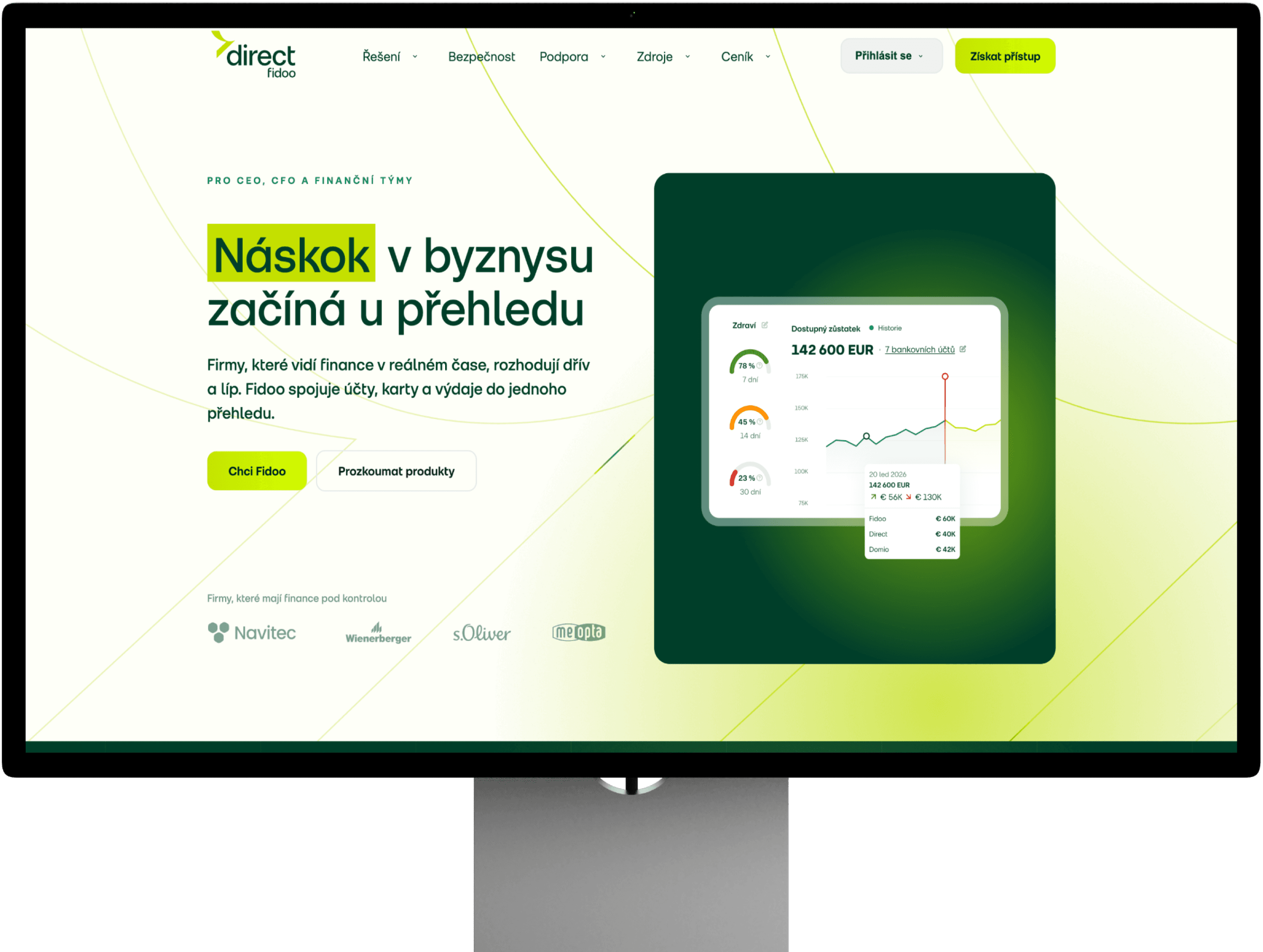
Two of our own projects show the embedded model at team scale. At Fidoo, 13 Cleevio specialists worked inside the client’s squads with the same tools, planning and reviews as Fidoo’s own people, and shared responsibility for the outcome. One year after kick-off, the new financial platform launched on web, iOS and Android.
- 13
- Cleevio specialists in Fidoo’s squads at peak
- 1 year
- from kick-off to public launch
- 3
- platforms: web, iOS and Android
- ~60%
- of the mobile coding workflow AI-assisted
What I value most about Cleevio is their ability to understand both the technology and the business behind it. They take real ownership, challenge assumptions when needed, and work with us as a true partner rather than just a development supplier.
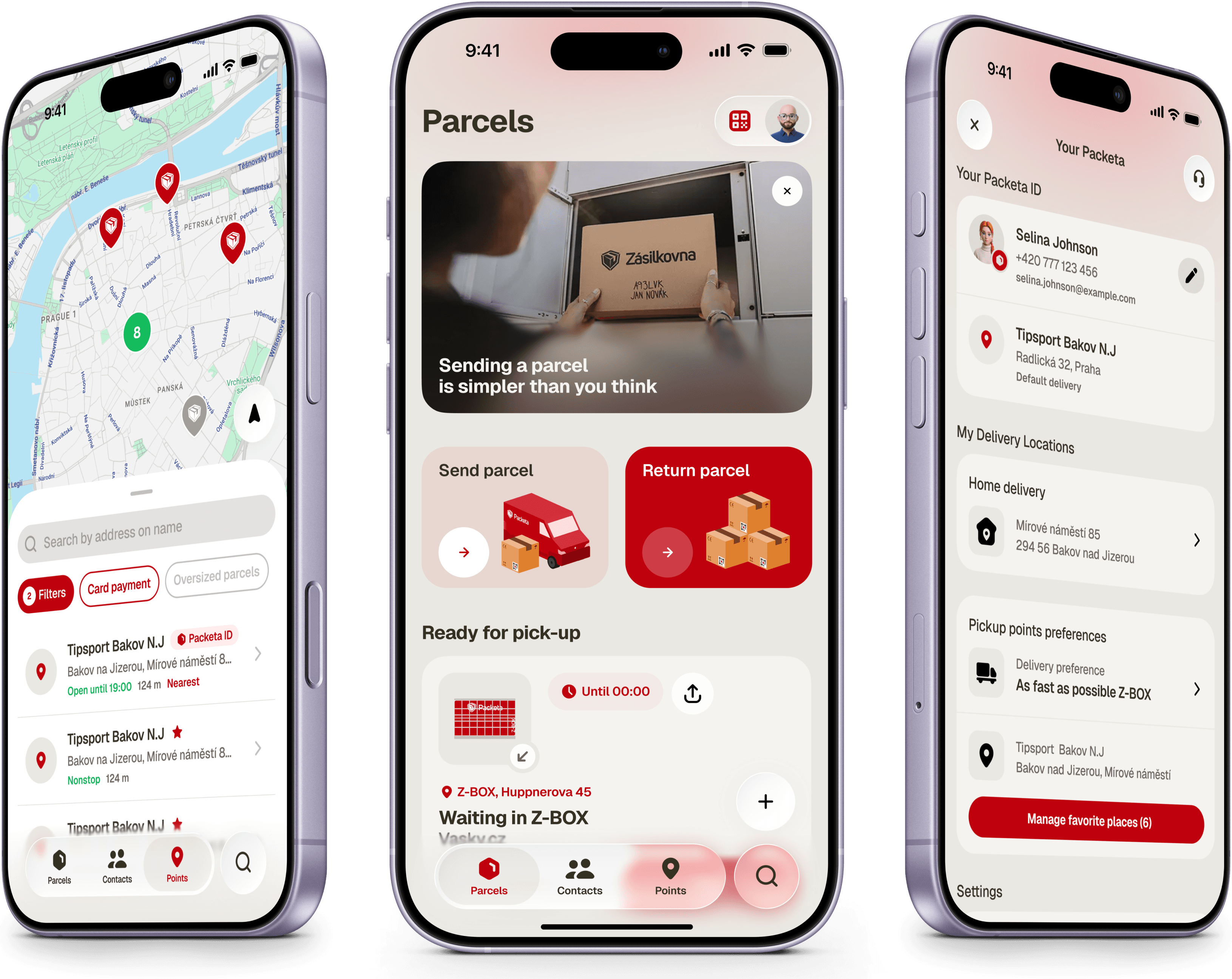
At Packeta, five people from Cleevio joined Packeta’s developers and our specialist led the joint team. AI agents wrote most of the code and developers reviewed every change. Development took five months. More than 2 million people in Czechia use the Packeta app every month, and the new version is rolling out to them gradually.

Can forward deployed engineers build a new company?
Yes. In a new venture the forward deployed team acts as the founding engineering team: it validates demand with customers, ships the first version and iterates with early users. AI coding agents take over much of the implementation, so a small team covers work that used to need a larger one.
We have built companies from their first version before. We co-founded RACEMAKE, and GoodTrust raised a $2.3M seed round on the MVP we built.
How do you hire a forward deployed engineer?
There are three routes, and the right one depends on how often the need will come back.
- Hire in-house. Suits a product company with many customers to deploy to. The profile is rare and in demand, so plan for a long search.
- Use the vendor’s engineers. When the work is fitting one vendor’s platform, its own forward deployed team usually comes with the contract.
- Bring in a partner. Suits a company that wants one problem solved and the result handed over to its own people.
Whichever route you take, four checks help.
- Ask for work in production. Examples that real users rely on today, with numbers.
- Ask who owns the outcome. The answer should name a person who stays through rollout.
- Agree the first scope. One problem, a baseline, a budget and a review point.
- Plan the handover. Code, documentation and access your team keeps.
For a sense of the profile, see the AI forward deployed engineer role at Cleevio. For the partner route, see forward deployed engineering at Cleevio.
What are the limits of forward deployed engineering?
Three limits are worth knowing before starting.
- It needs access. The engineer learns from the people doing the work, so their time and the relevant systems have to be available.
- It needs a decision-maker. A business owner who sets priorities keeps the work pointed at one outcome.
- It produces custom software. What gets built has to be maintained, by your team or by the partner, and that belongs in the plan from the first day.
Is a forward deployed engineer a software engineer?
- Yes. It is a software engineering job with two additions: direct work with the customer’s people and responsibility for the result after launch.
What is the difference between FDE and FDSE?
- They name the same role. FDSE stands for Forward Deployed Software Engineer, the title Palantir uses. FDE is the shorter form.
What is an AI forward deployed engineer?
- A forward deployed engineer whose work centres on AI systems: connecting language models and agents to a company’s data and tools, evaluating them on real tasks and running them with review points and cost limits.
Do forward deployed engineers work on site?
- Often, at least at the start. Time with the people doing the work is how the engineer learns the process. Many engagements then continue remotely or in a hybrid setup.
How do you become a forward deployed engineer?
- Most come from full-stack engineering. The additions are the ability to learn a business quickly, clear communication with non-technical people and practical experience with AI models and coding agents.
Forward deployed engineering is one of the ways we work with clients: an engineer or a small team, embedded with the people who know the problem.
Talk to us about your use case →