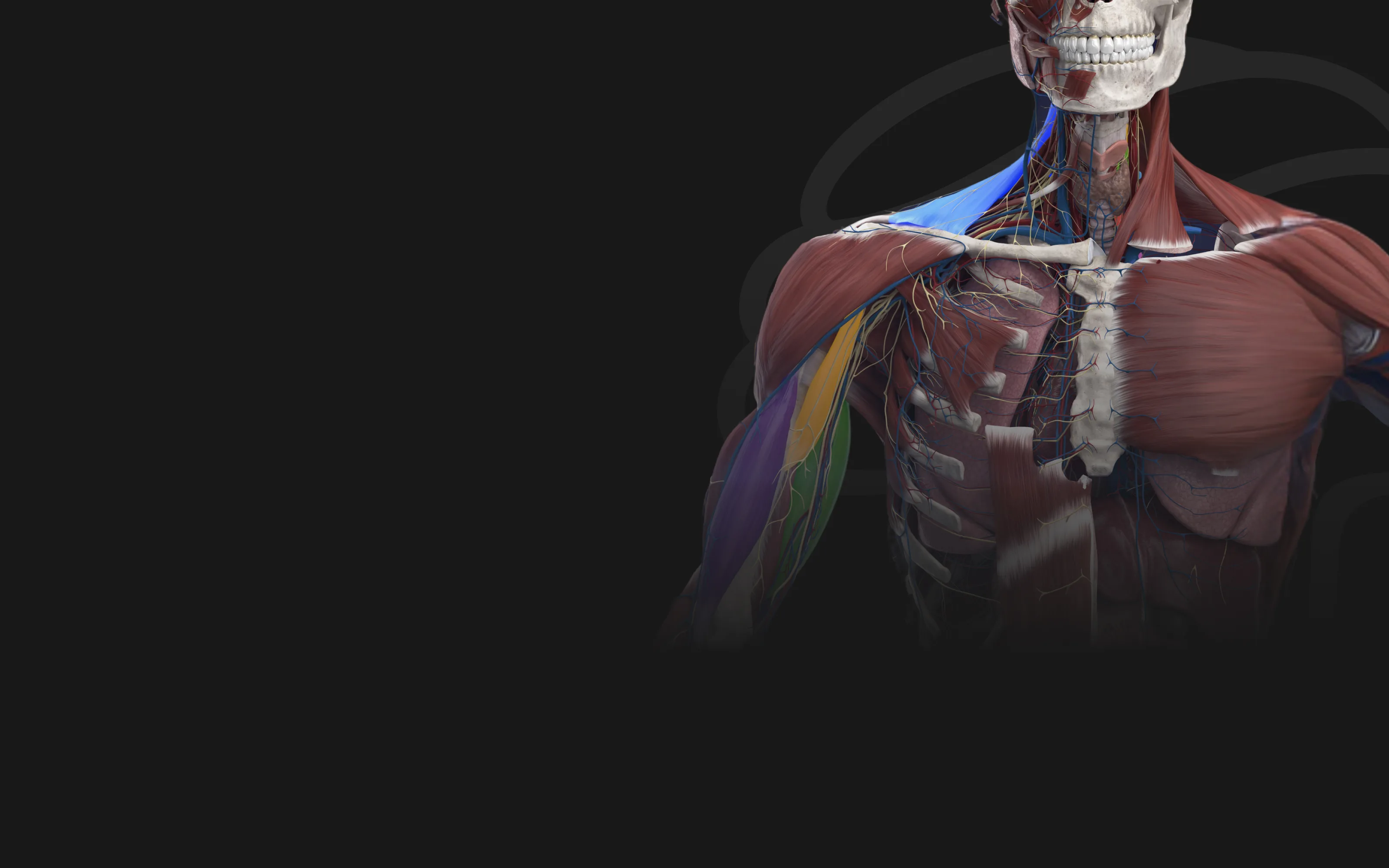
Active users in the first semester live
Memorix · Anatomy Tutor
Medicine has a specific problem with AI. Most places, a wrong answer costs you an argument. In anatomy, it costs you a wrong diagnosis five years later.
That’s the constraint we designed against when we built Anatomy Tutor, an AI learning platform for med students built for Memorix — the publisher behind Memorix anatomie, the reference textbook that’s taught generations of doctors across Czechia and Slovakia.
The need
Ask a general AI chatbot an anatomy question and it answers instantly, confidently — and sometimes wrong. A fabricated structure, an invented mnemonic, an anatomically impossible image.
The real risk isn’t the wrong answer, though. It’s what happens to the student reading it without a solid base of real knowledge yet — they stop checking and start trusting by default. Memorix’s team calls this cognitive capitulation. A future doctor who’s capitulated to AI instead of learning from it is a risk to their first real patient.
So the brief wasn’t “add a chatbot to the textbook.” It was: build an AI a med student can actually rely on, without letting them switch their brain off.
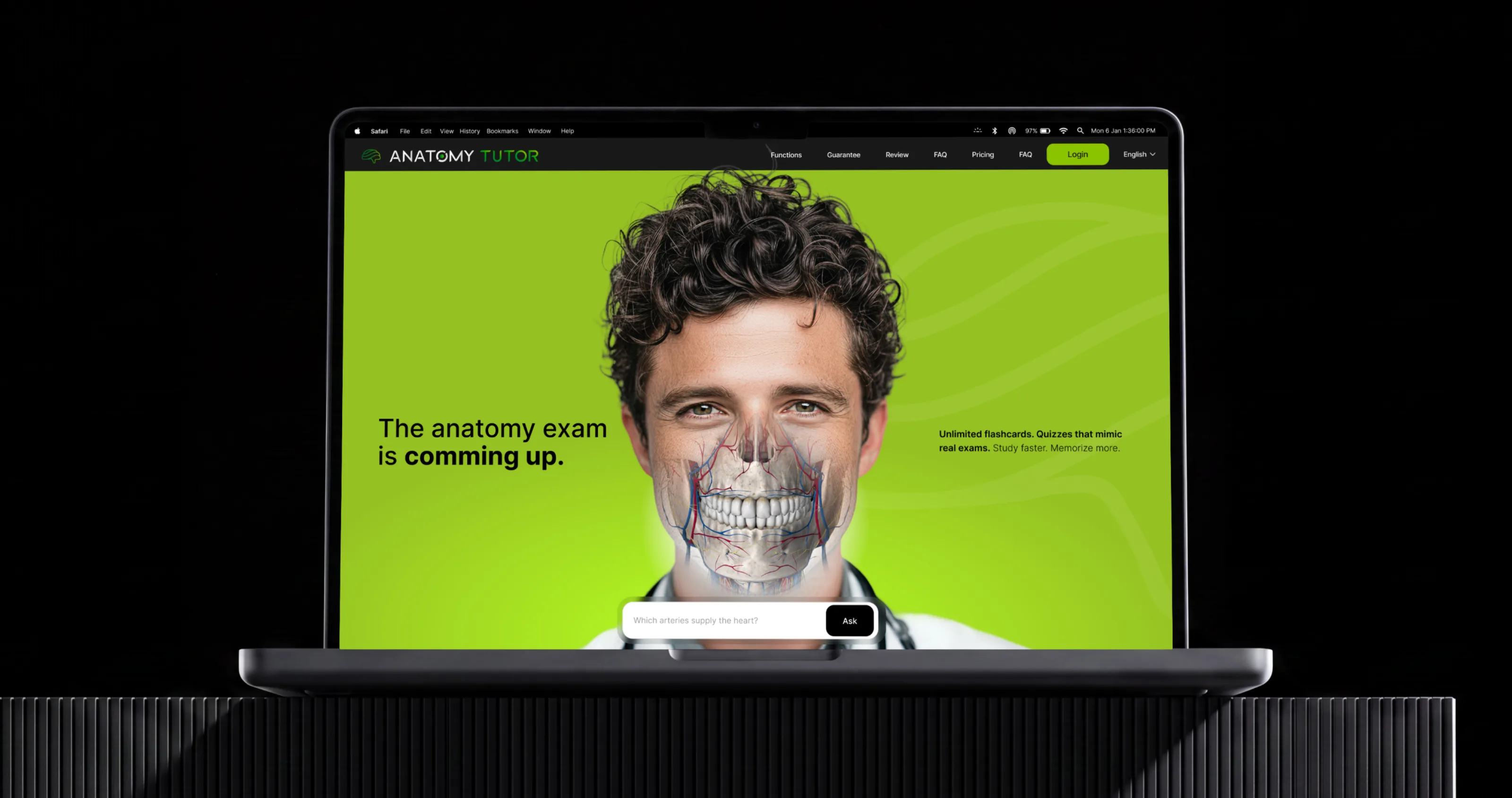

The Cleevio solution
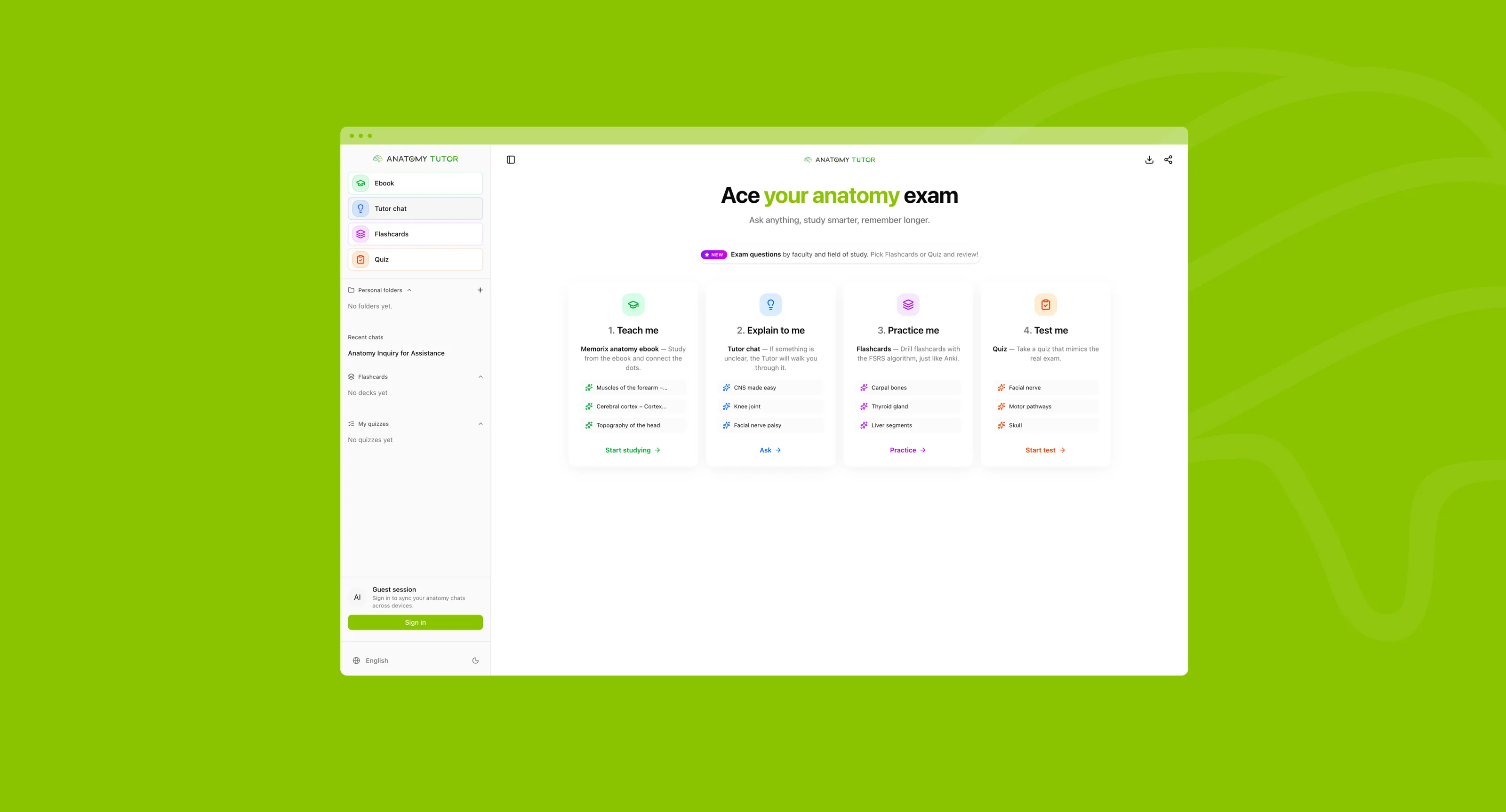
Most students prepping for an anatomy exam end up juggling the same messy setup: a PDF, a flashcard app, a quiz bank, and a group chat where someone finally explains the thing that never made sense. Anatomy Tutor replaces that pile with one connected cycle, all pulling from the same verified content.
Ebook — teach me.
An interactive version of Memorix anatomie.
Tutor Chat — explain it to me.
The AI students actually talk to.
Flashcards — test my memory.
The AI generates decks straight from Memorix content.
Quiz — prove it.
Single-choice, multiple-choice, open-ended — modeled on real exam formats.
1,110Active users in the first semester live
7Languages shipped
4.9/5Average student rating
The principle
If it’s not in Memorix, it doesn’t invent it
We weren’t the only ones thinking this way. OpenEvidence, an AI platform US doctors use for clinical decisions, closed a funding round in January 2026 that valued it at $12 billion — on one restriction: it only answers from verified medical literature, never the open internet. Doctors trust it because of what it refuses to do.
Anatomy Tutor runs on the same logic, just earlier in a doctor’s career. Everything the AI says has to trace back to Memorix anatomie. Not the model’s general training data, not the open internet. If it’s not in Memorix, it doesn’t invent it.
Phase 01
Ebook — teach me.
An interactive version of Memorix anatomie. Full-text search, persistent state so the app remembers exactly where a student stopped, highlighting, notes, smooth zoom on anatomical images. Reading is still the first step. It just isn’t a static PDF anymore.
Phase 02
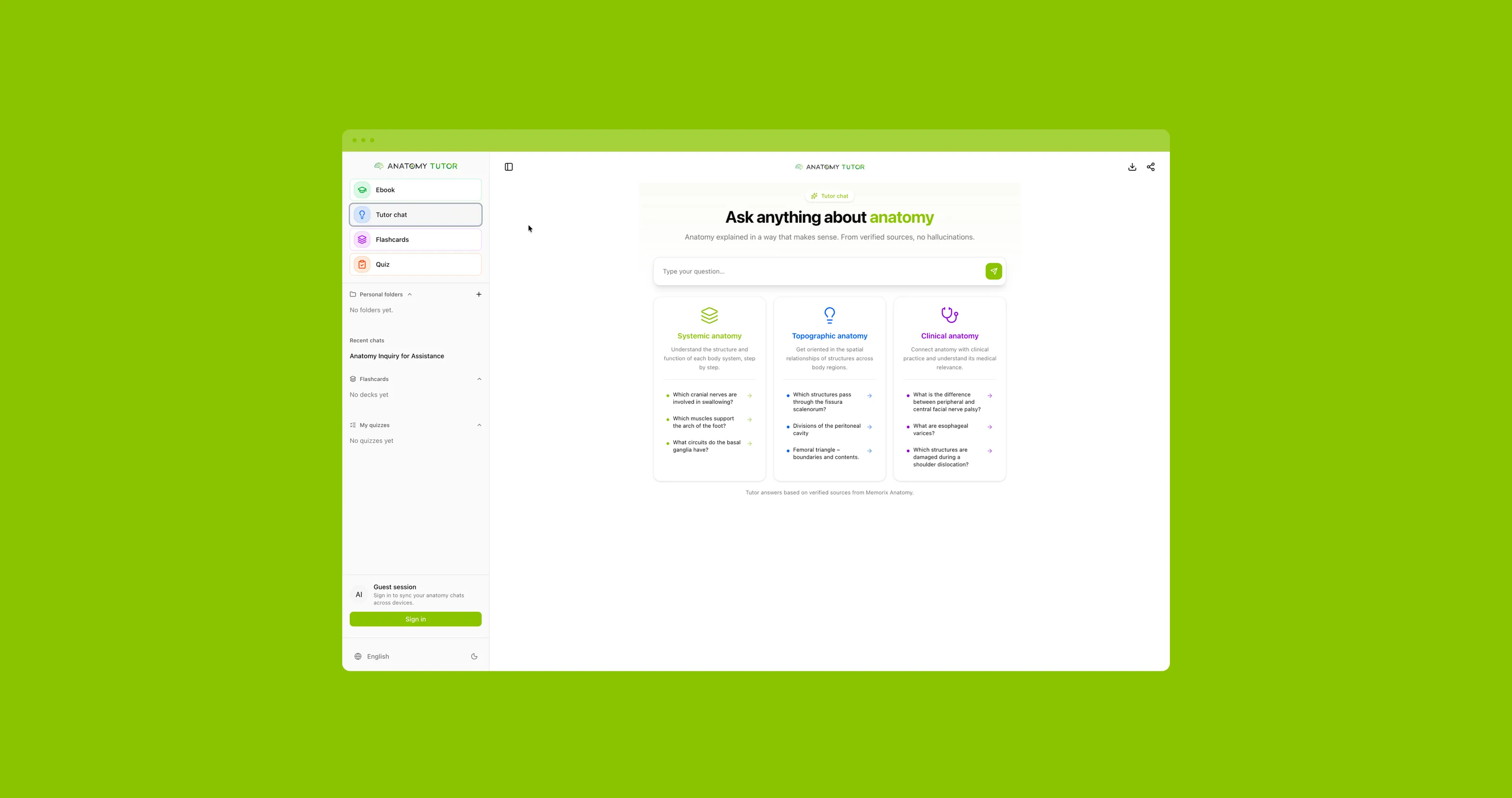
Tutor Chat — explain it to me.
The AI students actually talk to. Select a passage and ask for more depth, and it answers in context. Instead of just answering and stopping, it follows up with its own questions to check understanding, and it recommends relevant clinical cases on its own. From any answer, it can spin up a mini-quiz or mini-flashcard set on that exact topic, so understanding turns into practice without switching tabs.
Phase 03
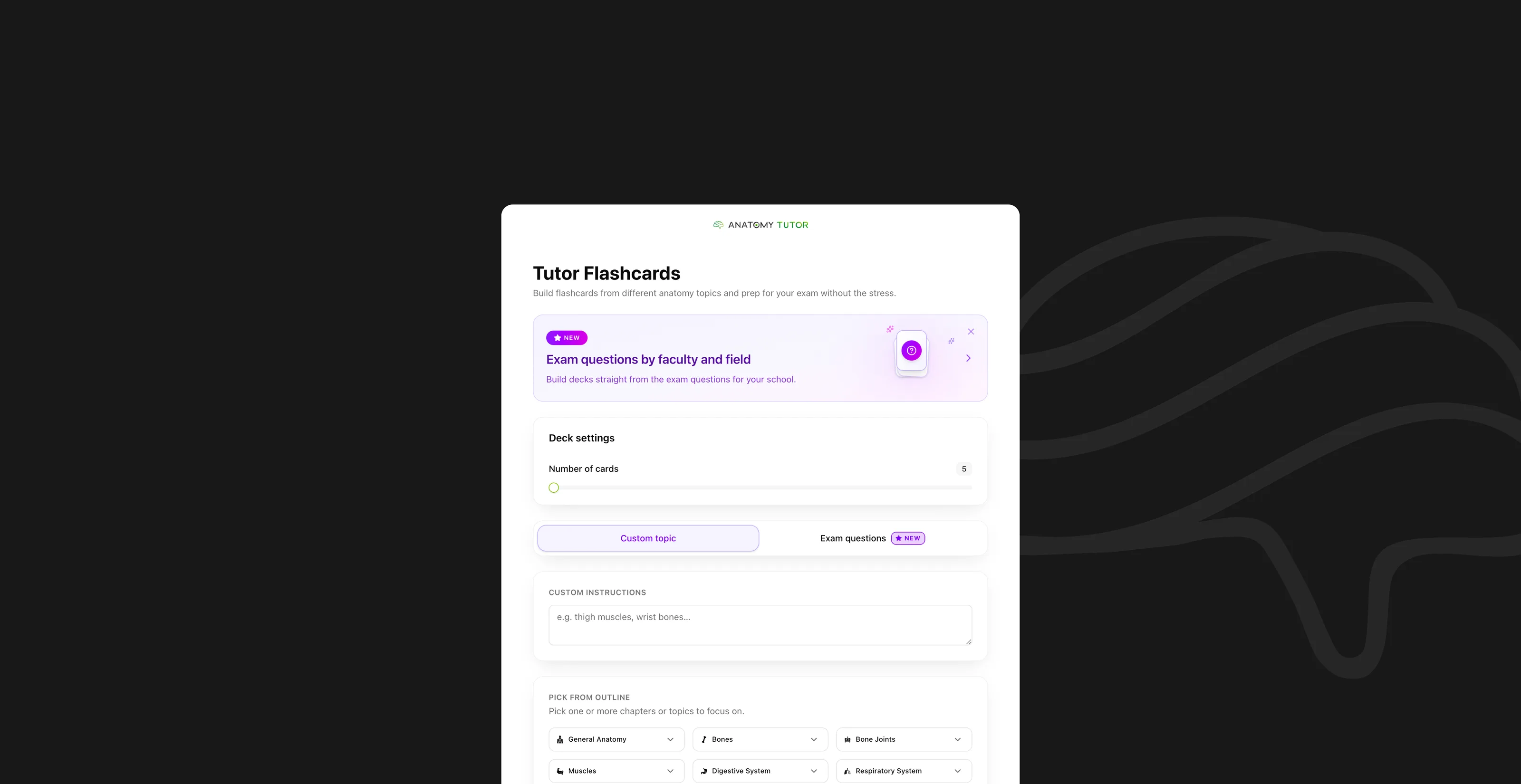
Flashcards — test my memory.
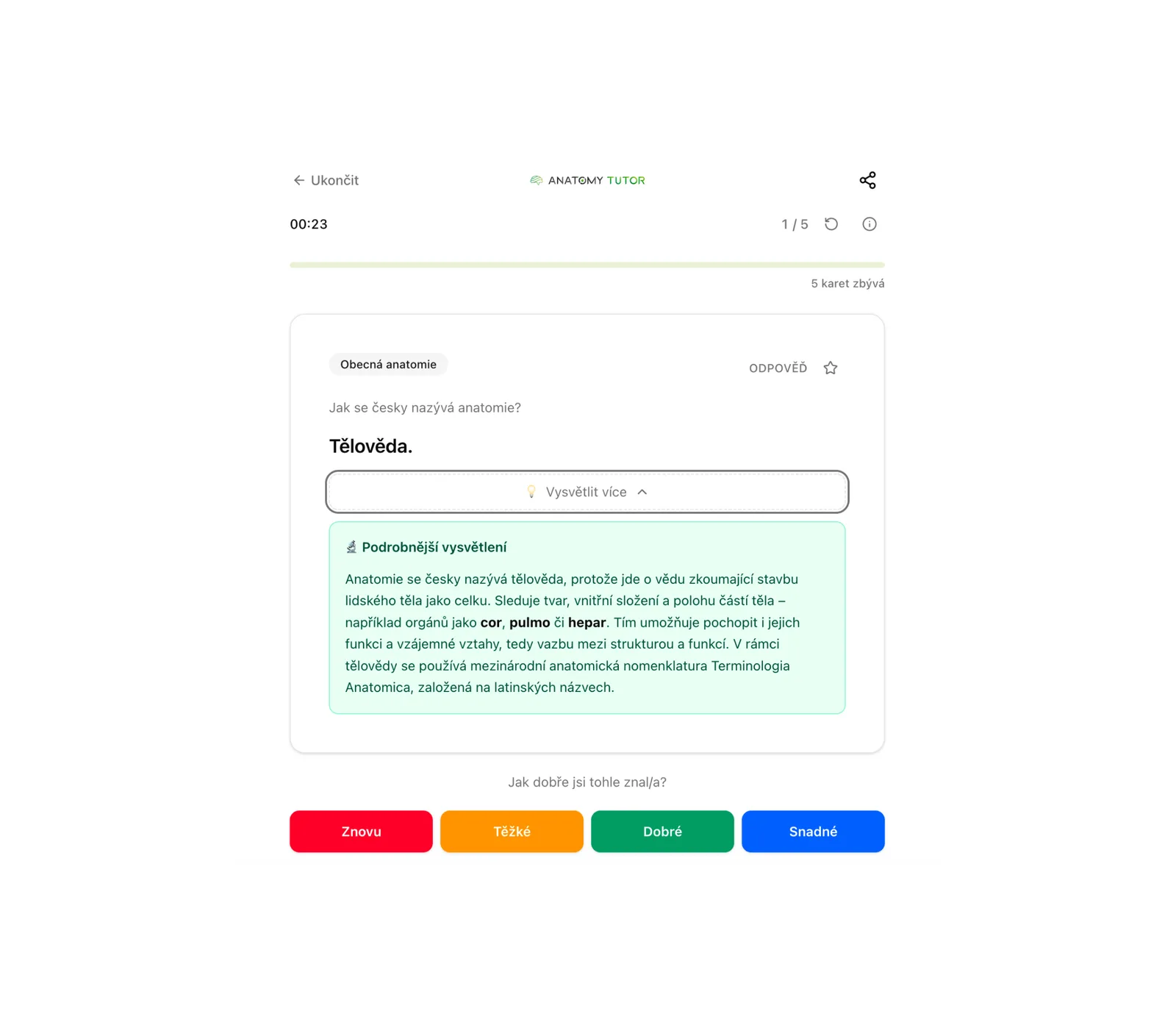
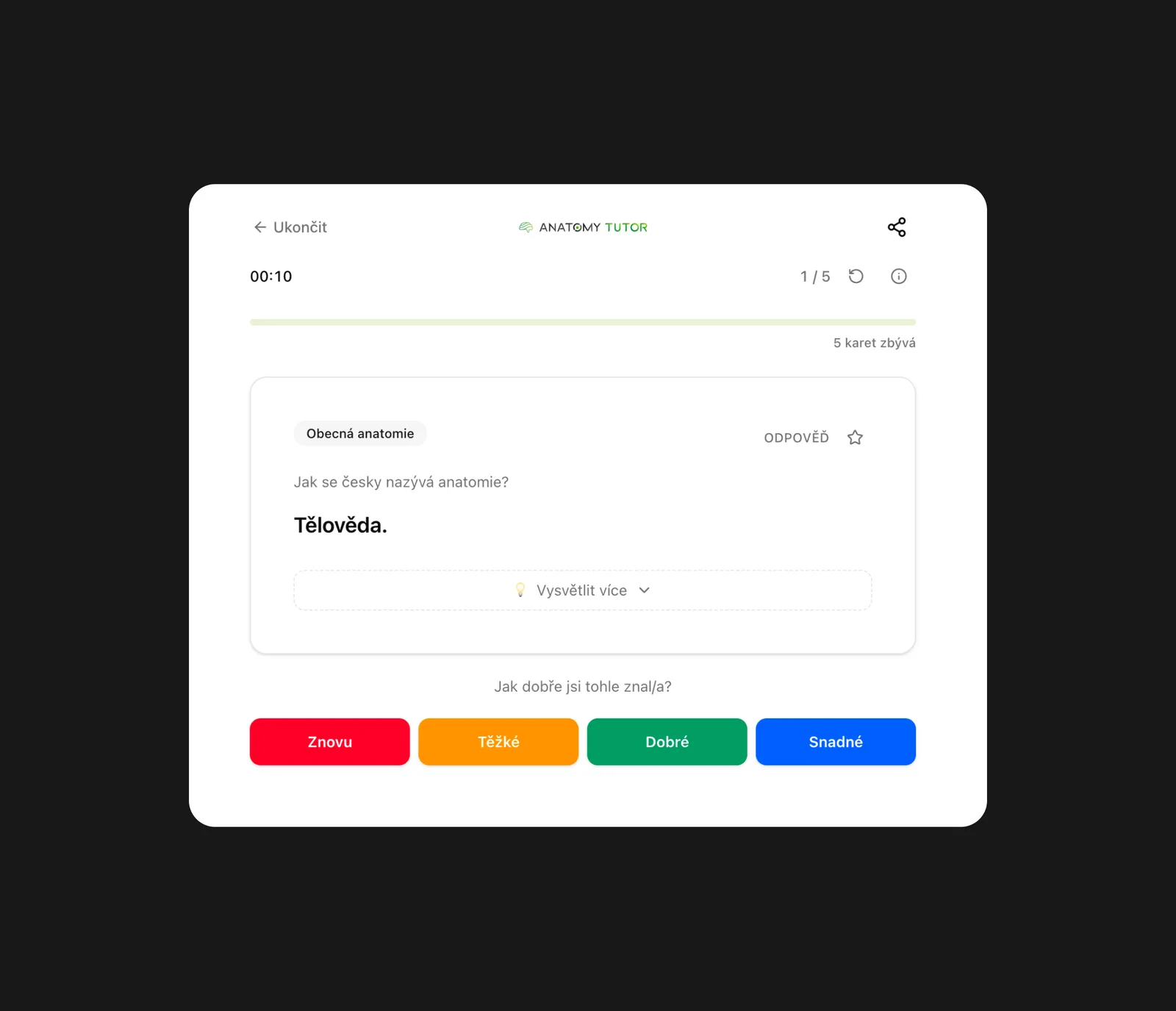
The AI generates decks straight from Memorix content, and instead of a fixed repetition schedule, we used FSRS — Free Spaced Repetition Scheduler. It adjusts how often a card comes back based on how the student actually rated it: Again, Hard, Good, Easy. Finish a set and the AI breaks down what’s actually sticking and what isn’t — not a vague sense of “I should probably go over nerves again,” but a real answer to what to study next.
Phase 04
Quiz — prove it.
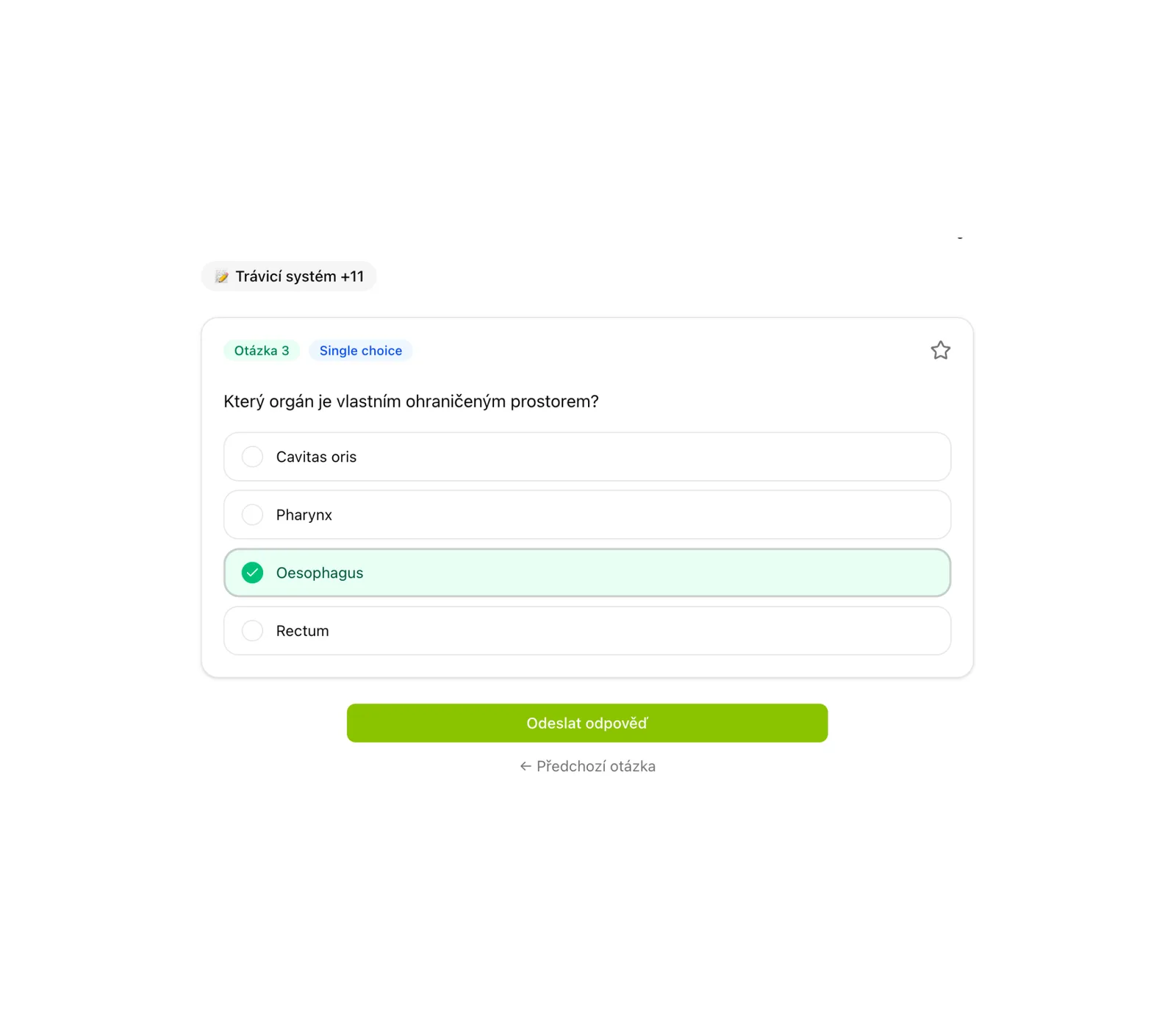
Single-choice, multiple-choice, open-ended — modeled on real exam formats, including question banks from every Czech and Slovak medical faculty, so a student practices against the exam they’re actually facing. Every answer comes with immediate feedback on what you picked, what you missed, and why — and finishing a quiz gives the same kind of breakdown as the flashcards: strong topics, weak topics, what to revisit.
That’s the part that’s easy to overlook but matters most. Normal studying doesn’t tell you where you actually stand until the real exam does. Here, a student gets that read after every session, not once a semester.
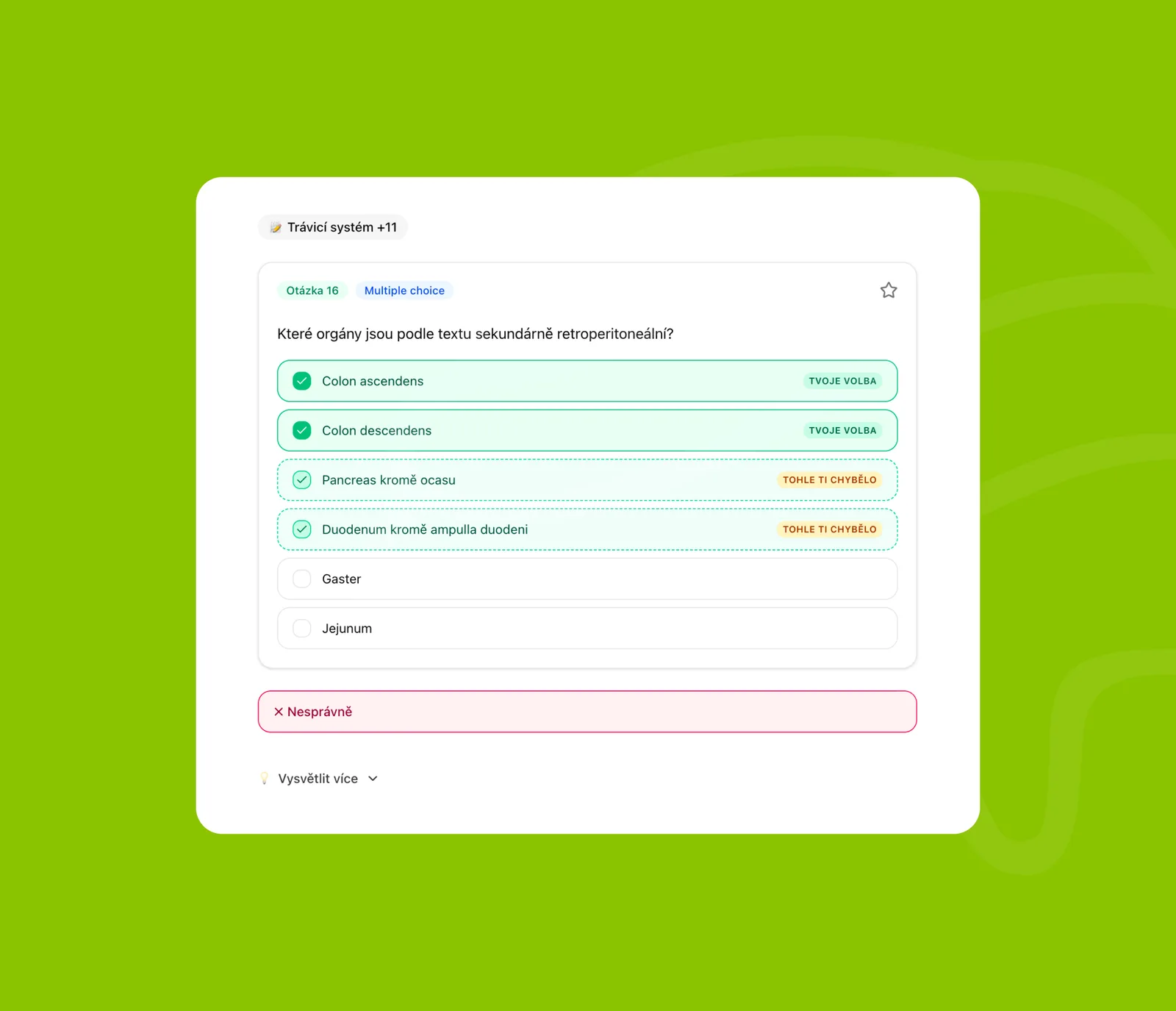
None of these four are separate features bolted together. They’re one funnel — passive reading, active questioning, practiced recall, verified knowledge — and a student can move through all four without ever leaving the source material or losing their place.
Passive readingActive questioningPracticed recallVerified knowledge
Reach
Built to travel
Anatomy Tutor now runs in 7 languages — Czech, Slovak, English, Spanish, Italian, Hungarian, Polish — which explains why students outside Czechia and Slovakia are already using it. It also carries exam question banks from every Czech and Slovak medical faculty, so the practice material lines up with the specific exam a student is studying for, not a generic anatomy syllabus.
The result
- 1,110 active users in its first semester live
- 7 languages shipped, with real usage from students outside CZ/SK
- 4.9/5 average student rating
- Adopted by students from 2nd Faculty of Medicine at Charles University, Masaryk University, Medical University of Warsaw, and other faculties across Central Europe
- Growth driven almost entirely by word of mouth and Instagram, no paid acquisition behind it
- Backed by three named medical authorities as content guarantors: MUDr. Radovan Hudák, prof. MUDr. David Kachlík, Ph.D., and doc. MUDr. Ondřej Volný, Ph.D.
Key metrics1,110 7 4.9/5
Languages shipped
Average student rating
Beyond medicine
What this means outside medicine
This isn’t just an anatomy problem. Any AI product working in a field where “roughly right” doesn’t cut it — finance, law, engineering, healthcare — runs into the same design choice: optimize for a confident answer, or optimize for a correct one, even when correct means saying “I don’t know.”
We picked the second option, for a much smaller team than the one behind that $12 billion bet in the US. Different market size. Same underlying call.
Try it yourself: 7-day free trial, no card required → chat.anatomytutor.ai
Read next



Awards & recognition






Second opinionAsk someone
Ask someone
who isn't us.
We've pre-loaded the context.
Ask what we're good at — and what we're not.
Opens a new chat, context already written.
Talk to us
Our AI sales agent knows the work cold — what we build, how a POC runs, what it'd cost for your case. Ask her now; she'll follow up by email to get you started.